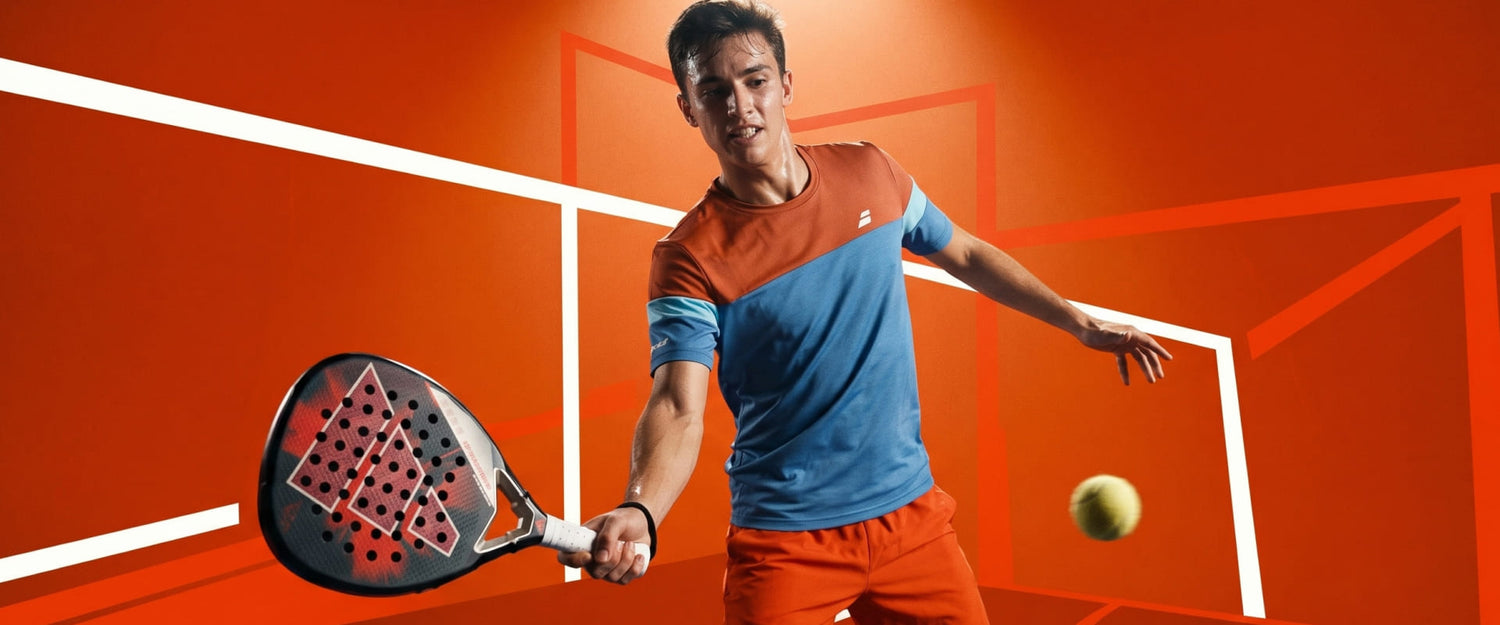
9 tips for tennis players transitioning to padel

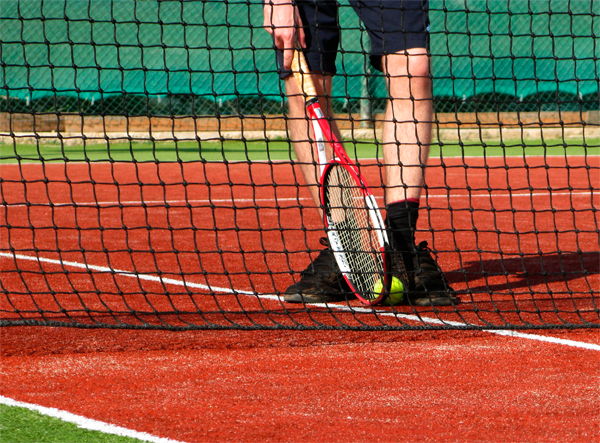
Many tennis players or fans end up taking up padel. At first glance, there seem to be many similarities between both sports. However, a deeper look reveals that there are significant differences between padel and tennis.
1st. The court and bounces
The first difference is in the court. As we know, in tennis only one bounce is allowed, while in padel, wall bounces are introduced.
2nd. Ball movements
In padel, the ball's movements due to bounces cause displacements to vary compared to tennis.
In tennis, we see that players often wait for the ball. Points involve a large number of shots from the back of the court, and net approaches are fewer and of a different nature. In tennis, approaching the net often wins the point, whereas in padel, being at the net does not guarantee point completion.3rd. Difference in groundstrokes
Regarding the analysis of strokes, we see the first differences in groundstrokes. In tennis, the preparation for groundstrokes is more extensive and has a longer follow-through. Additionally, grips are more closed in tennis compared to padel.4th. Turns and shots from wall exits
Another situation that does not occur in padel but does in tennis is that in the latter sport, players often wait for the ball before striking. In padel, we let it pass to wait for the bounce off the walls. Therefore, the turns when hitting shots from wall exits or off double walls are characteristic of this sport. Perhaps this is why players find the greatest difficulty in transitioning from tennis to padel in this difference in movements.
5th. Ball bounce
The ball's bounce can be a minor handicap, as tennis is usually played on fast courts and clay courts most of the time. However, it is true that this point is not a very influential parameter.
6th. Volleys and smashes
Where we might see greater similarity or where a tennis player feels most comfortable in their first padel matches is with net shots, as these involve volleys and smashes.
In the analysis of volleys, the difference a player must consider is the shot preparation, as in padel it is shorter and slightly faster than in tennis, and it is not as definitive a shot as in tennis.
As for the smash, we could say that they are almost identical in terms of preparation. The only difference is that in padel, both the flat smash (to take it out x4) and the topspin smash (to take it out x3) are used. In tennis, the smash used is flat and is usually decisive in a high percentage of cases.
Similar to the topspin smash used to take the ball out x3 in padel, in tennis we find it with the serve used on clay courts, seeking a higher bounce, and for second serves where the aim is not so much to win the point, but to get a ball that allows staying in the point, i.e., a safer serve.
7th. Court exits
In this section, we must mention court exits, which allow the player to continue the point after an x3 smash, where the opponent can leave the court to continue the point. In this case, it is a new concept for the player coming from tennis, as are wall exits after a smash that failed to take the ball out x4. The act of going for the ball is difficult for players to adapt to.
8th. The bandeja shot
One of the points where we might find the greatest difficulty, at first, is in the bandeja shot, as it is a shot that does not occur in tennis, and in padel, the ball must be allowed to drop more than the player is accustomed to.
9th. Shot power
Finally, the last point that players must consider is the power of their shots, as less power is used in padel.
However, the best advice, which summarizes all the above, and which we would like to share with all players starting in padel, is patience and adaptation.