[caption id="attachment_12164" align="alignnone" width="750"]
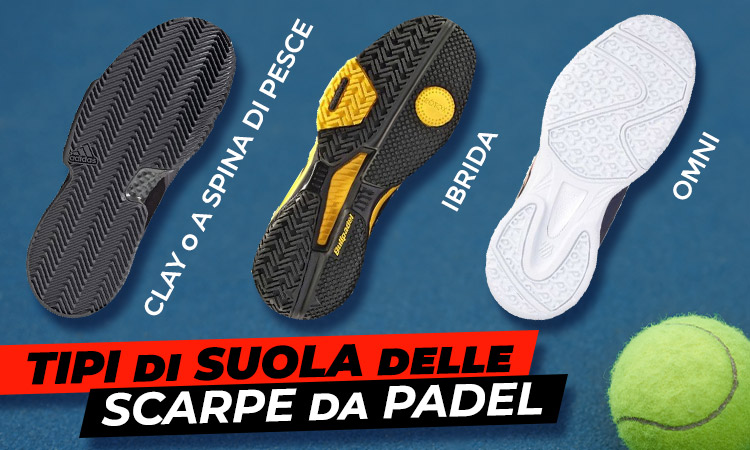
Types of Padel Shoe Soles[/caption]
As in all sports, padel also requires accessories and complements to play correctly and safely. One of the most important complements in this sport is, without a doubt, shoes. That's why it's important to choose them well and understand, among the different types of
padel shoe soles, which one best suits your needs.
When it comes to footwear, the sole is a very important element. It is the part of the shoe that influences a player's performance and the risk of injury. Currently, there are different types of soles on the market, and each one adapts to a specific profile. In this post, we have divided the three main types of soles to better understand their use and in what situations they can be used.
Which of the different types of padel shoe soles is the best?
Clay or herringbone sole
The herringbone sole is the most famous and used in the world of tennis, and now it is also in padel. The clay or herringbone sole can be quickly identified by its typical design. It is a sole composed of parallel lines in the shape of triangles and completely devoid of studs. The main quality of this type of sole is traction; in fact, it is the one that adheres best to the ground.
This is very important when playing on a padel court with a lot of sand, to avoid unwanted "slips". Furthermore, this type of sole, devoid of studs and other structures, has a longer lifespan and is more resistant to wear. Another advantage is that, despite having strong grip, it also allows you to slide when you need quick movement to retrieve a ball.
Omni sole
The omni sole is recognizable because its design consists of small dots or micro studs. In fact, many players know it as the "dotted sole". The strong point of this type of sole, as with the clay sole, is its grip. Its ideal terrain is artificial grass (the surface of most padel courts today). However, one of its downsides is its lack of versatility, meaning it is only suitable for that type of surface.
If you happen to find a court with a cemented surface, or artificial grass, but with a lot of sand, the traction will not be sufficient. This could lead to a higher risk of slipping and poorer material durability. It could be said that this type of sole is the least frequently found in the world of padel.
Mixed or hybrid sole
The mixed or hybrid sole has gained enormous popularity. It is currently classified as one of the favorites among most players. As the name suggests, the sole is hybrid, meaning it combines elements found in herringbone and omni soles. The goal is for the shoes to be functional and therefore usable on any type of court. Thanks to its versatility, we could play almost anywhere, on artificial grass, cement, and with little or a lot of sand.
Many of the most prestigious brands have started to incorporate this sole into their most emblematic models. You can find them under the name "All Court". Some of the best-selling shoes currently, which have this type of sole, are those from the new Bullpadel collection, such as the new Hack Hybrid Fly, Vertex Hybrid Fly, and Flow Hybrid Fly.
Which of these is the best?
At this point, one wonders: which is the best type of padel sole? You surely expected this answer, but we can tell you with certainty that none of the three is better than the other. The choice must be based on the surface on which you play most often. If we usually play on standard padel courts, with the basic characteristics of a FIP-approved terrain, then it is advisable to choose a herringbone sole. Furthermore, this type of sole has a certain degree of versatility, allowing it to adapt to other surfaces as well.
If, however, you are a player who only needs traction on artificial grass courts, shoes with omni soles are excellent. However, we can also fully recommend hybrid soles. For example, the new Bullpadel shoe models we mentioned above are used by World Padel Tour players, which indicates that they are compatible with any type of surface.